

Food-Grade Coconut Shell Powdered Activated Carbon (PAC) - 80x325 Mesh, Acid-Washed
Food-Grade Coconut Shell Powdered Activated Carbon (PAC) - 80x325 Mesh, Acid-Washed - 80x325 / Trial bag - 27.5 lb (12.5kg) is backordered and will ship as soon as it is back in stock.
Couldn't load pickup availability
Bulk pallet & supersack discount - save on 2+ pallets or supersacks. Live freight quotes at checkout.
| Qty | Discount |
|---|---|
| Buy 2 | 5% off each |
| Buy 4 | 10% off each |
Overview
Food-Grade Coconut Shell Powdered Activated Carbon (PAC), 80×325 Mesh is a fine, acid-washed adsorption media supplied by Carbon Activated Corporation for compatible food, beverage, ingredient, edible-oil, process-water and industrial liquid-treatment applications.
Unlike granular activated carbon that remains inside a fixed treatment bed, powdered activated carbon is dosed directly into the liquid, allowed to contact the target compounds, and then removed through filtration or another solids-separation step. Its fine particle size provides short diffusion paths and high relative surface exposure for rapid batch or continuous-contact treatment.
The coconut-shell base generally provides strong micropore development, while acid washing helps reduce residual mineral matter and soluble inorganic impurities. Final performance still depends on the target compound, dose, contact conditions, process-liquid chemistry and downstream filtration.
For broader guidance on activated-carbon forms, pore structure and specifications, see our Activated Carbon Practical Guide or browse the full Activated Carbon collection .
Carbon type: Food-grade, acid-washed coconut-shell powdered activated carbon
Physical form: PAC for dose-contact-separate treatment
Commercial particle-size designation: 80×325 mesh
Available packaging: 27.5 lb (12.47 kg) bags and 1,100 lb (approximately 499 kg) supersacks
Common uses: Beverage polishing, ingredient purification, edible-oil treatment, color reduction and batch liquid purification
Primary applications
- Beverage processing: Selected color, taste, odor and dissolved-organic reduction in compatible beverage and process streams.
- Syrups & sweeteners: Batch decolorization and polishing where powdered carbon can be mixed with the liquid and subsequently removed.
- Ingredient purification: Treatment of compatible liquid ingredients where carbon purity, extractables and sensory impact are important qualification factors.
- Edible-oil processing: Supplemental adsorption of selected color bodies and organic impurities in compatible refining or polishing processes.
- Food-process water: Batch or dosed treatment where a suitably qualified food-grade powdered activated carbon is required.
- Industrial process liquids: Contact treatment for selected odors, color bodies and dissolved organic compounds.
- Wastewater polishing: PAC dosing for selected residual organics before clarification, flotation or filtration.
- Pilot & laboratory trials: Jar testing and dose-response evaluation before production-scale treatment.
Why choose acid-washed coconut-shell PAC?
- Rapid mass transfer: Fine powdered particles provide short diffusion paths and extensive contact with the treated liquid.
- Coconut-shell pore structure: Commonly emphasizes microporosity and can be useful for many smaller dissolved organic compounds.
- Acid-washed processing: Helps reduce residual ash, soluble minerals and certain inorganic extractables compared with the unwashed starting carbon.
- Food-grade supplied grade: Supplied by Carbon Activated Corporation for compatible food, beverage, ingredient and process applications, subject to exact application qualification.
- Flexible dose control: Carbon dosage can be adjusted as feed quality or treatment requirements change.
- Adjustable treatment conditions: Mixing, contact time, temperature and filtration can be optimized around the actual process.
- Scalable packaging: Available for bench work, intermittent production and recurring industrial use.
Exact ash, acid-soluble matter, pH, iodine number, moisture, particle-size distribution, purity limits and regulatory details depend on the supplied grade and should be confirmed using current manufacturer documentation when required.
PAC and GAC solve the same broad adsorption problem in very different ways.
PAC is added directly to the process liquid and later removed. GAC remains physically retained inside a vessel or filter bed while the liquid flows through it. PAC is useful when flexible dosing and direct contact are desirable; GAC is generally better suited to continuous retained-bed service.
Compare fixed-bed options: Coconut-Shell GAC · Coal-Based GAC
What does 80×325 mesh mean?
80×325 is the commercial particle-size designation used for this powdered activated-carbon grade. An 80-mesh opening is approximately 180 microns, while a 325-mesh opening is approximately 45 microns.
The designation identifies a fine powdered carbon associated with this general particle-size range. It should not be interpreted to mean every particle falls strictly between approximately 45 and 180 microns unless that distribution is confirmed by the current manufacturer's particle-size specification or lot-specific data.
| Characteristic | Process implication |
|---|---|
| Fine particle size | Provides short diffusion paths and rapid contact during treatment |
| High relative external surface exposure | Helps the carbon contact the treated liquid rapidly |
| Powdered form | Requires a downstream solids-separation step |
| Fine-particle carryover risk | Filtration or clarification must be capable of retaining the PAC |
| Dust generation potential | Requires controlled transfer, ventilation and appropriate dust handling |
What can this PAC reduce?
| Treatment objective | General suitability | Important considerations |
|---|---|---|
| Color bodies | Application dependent | Performance depends strongly on molecular size, pore compatibility, carbon dose, pH, temperature and competing compounds |
| Taste & odor compounds | Common polishing application | Confirm performance using the actual beverage, water, syrup or process matrix |
| Dissolved organic compounds | Suitable for many compatible compounds | Adsorption varies by molecular structure, concentration, polarity, pore-size compatibility and competing organic loading |
| Selected oxidation products | May provide useful reduction | Bench testing should establish whether the compounds have useful affinity for this carbon |
| Residual odor or flavor compounds | Potentially suitable | Carbon purity, dose, contact time and downstream fines removal are especially important in sensory-sensitive products |
| Dissolved metals & inorganic salts | Not the primary function of standard PAC | Acid washing reduces certain impurities within the supplied carbon but does not make PAC a universal metals-removal adsorbent |
Important: Activated carbon is not equally effective for every target compound. Representative treatment trials using the actual liquid are recommended before scaling a new PAC process.
PAC treatment vs. fixed-bed GAC
| Selection factor | Powdered Activated Carbon | Granular Activated Carbon |
|---|---|---|
| How the carbon is used | Dosed into and mixed with the process liquid | Retained inside a vessel, column or filter bed |
| Process mode | Batch, intermittent or continuous dosing | Continuous flow-through treatment |
| Dosage flexibility | High | Media inventory is fixed by bed size |
| Relative mass-transfer rate | Generally rapid because of fine particle size | Depends on granule size, pore structure and bed conditions |
| Downstream separation | Required after treatment | Carbon remains retained within the vessel |
| Common starting fit | Batch purification, dose-response treatment, decolorization and process liquids with variable treatment demand | Continuous water, liquid and compatible fixed-bed purification |
Typical product characteristics
| Product type | Food-grade powdered activated carbon |
|---|---|
| Carbon source | Coconut shell |
| Processing | Acid washed |
| Commercial particle size | 80×325 mesh |
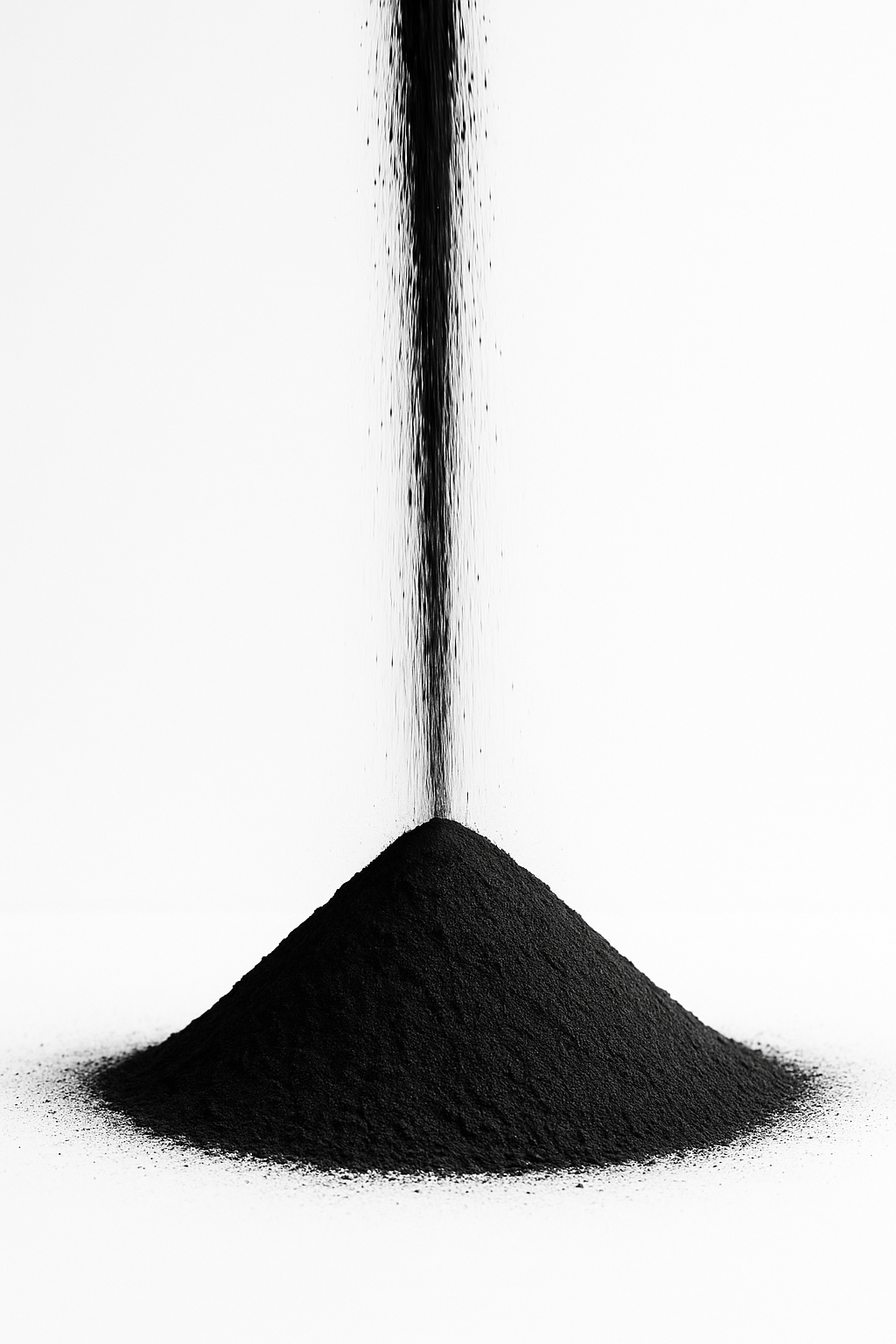
| Physical form | Fine black powder |
| Primary treatment mode | Batch dosing, slurry addition or compatible continuous-feed treatment followed by solids separation |
| Common treatment functions | Selected color reduction, taste-and-odor correction, dissolved-organic adsorption and liquid polishing |
| Supplier | Carbon Activated Corporation |
| Available packaging | 27.5 lb bags and 1,100 lb supersacks |
Documentation note: This product is supplied as a food-grade, acid-washed coconut-shell powdered activated carbon by Carbon Activated Corporation. Grade-specific values such as ash, moisture, pH, iodine number, particle-size distribution and applicable regulatory or certification details should be confirmed through current manufacturer documentation when required for qualification.
How powdered activated carbon is used
| Process stage | General approach |
|---|---|
| 1. Characterize the untreated liquid | Establish baseline color, odor, target contaminants, pH, solids, temperature and other relevant process properties |
| 2. Establish trial doses | Evaluate multiple PAC additions rather than assuming one universal treatment rate |
| 3. Disperse the PAC | Add under controlled agitation to promote wetting and uniform carbon distribution |
| 4. Provide contact time | Maintain representative mixing or residence conditions so adsorption can occur |
| 5. Separate the carbon | Remove PAC using appropriate filtration, clarification, flotation, centrifugation or another compatible solids-separation method |
| 6. Evaluate the treated liquid | Measure treatment performance, clarity, filtration behavior, product yield and downstream suitability |
The PAC process is a treatment cycle, not simply a carbon dosage.
Useful performance depends on the entire sequence: dose → dispersion → contact → adsorption → carbon capture → treated-liquid evaluation. Increasing carbon dosage cannot compensate indefinitely for poor mixing, inadequate contact time or ineffective downstream filtration.
Application & dosing guidance
Appropriate PAC dosage depends on the treated liquid, target compound, incoming concentration, required finished quality, carbon grade, temperature, pH, mixing intensity, contact time, competing organics and downstream filtration system.
- Begin with controlled jar tests or bench trials using the actual process liquid.
- Evaluate several carbon dosages to establish a dose-response relationship.
- Keep mixing, temperature and contact time consistent when comparing doses.
- Allow sufficient contact before attempting solids separation.
- Evaluate contaminant reduction together with product yield, product loss and filtration behavior.
- Confirm that the downstream filtration system can retain fine PAC particles.
- Evaluate final liquid quality against all applicable technical and sensory specifications before scale-up.
No universal PAC dosage is provided because treatment rate is highly application specific. A dosage suitable for one beverage, syrup, oil, ingredient or wastewater stream may be ineffective or excessive in another.
PAC capture & filtration options
| Separation method | Potential use | Considerations |
|---|---|---|
| Filter press | Batch treatment of oils, syrups, ingredients and compatible process liquids | Filter aid or precoat may be useful depending on PAC loading, liquid properties and required cake behavior |
| Pressure-leaf filtration | Production-scale polishing and batch clarification | Precoat and body-feed practices may support cake formation and throughput in compatible systems |
| Depth filtration | Lower PAC loading and polishing applications | Confirm particle-retention efficiency, loading capacity and required clarity |
| Dissolved-air flotation | Wastewater and selected industrial treatment systems | Performance depends on coagulation, flocculation, solids loading and float characteristics |
| Centrifugation | Processes with suitable density and solids-separation characteristics | Fine residual particles may require downstream polishing filtration |
| Membrane filtration | Selected water and process systems | PAC carryover can foul downstream membranes if upstream carbon capture is inadequate |
The appropriate separation method should be confirmed through trials and equipment-specific review.
When a filter aid may be useful
Fine PAC can create a demanding solids-separation step in some process liquids. Depending on the filtration equipment and product, a precoat or compatible filter aid may help establish a more permeable cake and improve PAC retention.
For applications where filter-cake permeability and mechanical clarification are key constraints, see our Diatomaceous Earth Filter Aid for Industrial Filtration guide.
For food and beverage processes specifically, see Diatomaceous Earth Filter Aid for Food & Beverage Processing .
Packaging & availability
| Package size | Typical use |
|---|---|
| 27.5 lb (12.47 kg) bag | Bench trials, pilot treatment, intermittent batch dosing, smaller production runs and manual addition |
| 1,100 lb (approximately 499 kg) supersack | Recurring production use, high-volume contact treatment and compatible bulk handling systems |
- Bag orders: Suitable for trials, intermittent production and controlled manual dosing
- Supersack orders: Suitable for recurring industrial demand and compatible bulk material handling
- Freight: Parcel, pallet or LTL service based on package size, quantity and destination
- Lead time: Confirmed at quotation or order placement
- Volume purchasing: Contact Sorbents Direct for pallet quantities, recurring requirements or delivered bulk pricing
Handling & storage
- Store unused PAC in a clean, dry, protected location.
- Keep bags and supersacks closed until use.
- Protect the carbon from contamination by oils, chemicals, odors and foreign material.
- Minimize airborne dust during opening, transfer, weighing and mixing.
- Use suitable dust collection, ventilation and personal protective equipment as specified by the current SDS.
- Ground and bond applicable handling equipment where required by the facility's combustible-dust controls.
- Keep activated carbon away from strong oxidizers and incompatible chemicals identified in current product documentation.
- Manage spent carbon according to the compounds it has adsorbed and applicable waste requirements.
Important: Powdered activated carbon is a fine combustible particulate material. Review current manufacturer safety documentation and site-specific dust controls before unloading, transfer, dosing, storage or cleanup.
Food, beverage & regulated-use considerations
This product is supplied as a food-grade, acid-washed coconut-shell PAC. That description does not mean every regulatory or certification requirement automatically applies to every use. Qualification should be based on the exact supplied grade and market requirements.
Before ordering, identify any required documentation such as:
- Food Chemicals Codex or equivalent compliance documentation
- Processing-aid or food-use statements
- NSF/ANSI certification where required for potable-water treatment
- Heavy-metal or elemental-impurity limits
- Microbiological requirements
- Acid-soluble ash or extractables limits
- Allergen, animal-origin or GMO statements
- Kosher or Halal requirements
- Country-specific regulatory documentation
Sorbents Direct can request available supporting documentation from Carbon Activated Corporation. Confirm all required technical, regulatory and lot-specific documents before approval for a regulated process.
Why buy from Sorbents Direct?
Powdered activated-carbon selection involves more than choosing a particle size. Sorbents Direct helps industrial buyers evaluate carbon source, washing treatment, packaging, documentation, dosage, process conditions and downstream solids separation.
- Transparent online pricing on qualifying package sizes and variants
- Small and bulk formats for trials, intermittent dosing and ongoing production
- Live freight quotes at checkout for eligible shipments
- Manufacturer-document support including SDS, TDS, COA and available compliance documentation
- Application guidance around dosing, contact time, mixing and downstream filtration
- Bulk purchasing assistance for recurring industrial requirements
- Process-media support when PAC must be integrated with filter aids or other purification media
Need another activated-carbon form?
Browse the Activated Carbon collection for powdered activated carbon, coconut-shell GAC, coal-based GAC, pelletized carbon and other industrial adsorption media.
For larger commercial requirements, see Bulk Industrial Adsorbents & Filtration Media Supplier .
Documentation & quality support
Available documentation may include:
- Safety Data Sheet (SDS)
- Technical Data Sheet (TDS)
- Certificate of Analysis for the supplied lot, when available
- Particle-size information
- Food-use or processing-aid documentation where applicable
- Additional regulatory or certification statements where available
- Packaging and freight information
This product is supplied by Carbon Activated Corporation as a food-grade, acid-washed coconut-shell PAC. Sorbents Direct does not currently display the grade-specific SDS or TDS online. Request current manufacturer documentation before purchase when technical limits, regulatory review, supplier qualification or lot approval are required.
Visit our Documentation Center or contact Sorbents Direct to discuss your application, dosage trial, filtration setup, packaging and documentation requirements.
Need help planning a PAC trial?
PAC performance depends on target compounds, process-liquid chemistry, carbon dosage, contact time, agitation, temperature, pH, downstream filtration, product-loss limits and required finished quality. Sorbents Direct can help identify the information needed for a controlled bench or plant trial.
Questions & answers
What is powdered activated carbon?
Powdered activated carbon is a fine adsorption media added directly to a compatible liquid for batch, intermittent or continuous-dose treatment. After contact, the carbon and adsorbed compounds must be removed using an appropriate solids-separation process.
What is the difference between PAC and GAC?
PAC is dosed directly into the treated liquid and later removed. GAC is granular carbon retained in a fixed bed or vessel while the process stream flows through it. PAC provides flexible dosage and rapid contact, while GAC is better suited to continuous retained-media systems.
What does 80×325 mesh mean?
It is the commercial particle-size designation for this PAC grade. An 80-mesh opening is approximately 180 microns and a 325-mesh opening is approximately 45 microns. The exact particle-size distribution should be confirmed through current manufacturer or lot documentation.
Why is the carbon acid washed?
Acid washing helps reduce residual mineral matter and certain soluble inorganic impurities in the activated carbon. The resulting ash and extractables specification depends on the exact grade and production process.
Is this carbon suitable for food and beverage processing?
It is supplied as a food-grade, acid-washed coconut-shell powdered activated carbon for compatible applications. Exact regulatory, purity and certification requirements should be confirmed before ordering.
Can this PAC be used for beverage decolorization?
It may be evaluated for beverage, syrup and ingredient decolorization, but performance depends on the chemistry and molecular size of the color bodies as well as carbon dosage and contact conditions. Representative process trials are recommended.
Can it be used in edible-oil refining?
Powdered activated carbon may be evaluated as a supplemental adsorbent in compatible edible-oil treatment processes. Grade, dosage, contact conditions, regulatory suitability and downstream filtration should be established using the actual oil and process.
How much PAC should I use?
There is no universal PAC dosage. Establish treatment rate through controlled bench or plant trials using the actual liquid, target compound, finished-quality requirement, contact conditions and downstream filtration system.
How is PAC removed after treatment?
Depending on the process, PAC may be removed using filter presses, pressure-leaf filtration, depth filtration, flotation, centrifugation or other compatible solids-separation equipment. Filter aids or precoats may improve carbon capture in some filtration systems.
Does a higher iodine number mean better PAC?
No. Iodine number characterizes one aspect of activated-carbon pore development but does not describe the full pore-size distribution or predict treatment performance for every compound. Actual process qualification should consider the complete carbon specification and the target liquid.
Is this product NSF certified?
NSF certification is not confirmed by this general listing. Request the applicable certification documentation before ordering when the carbon will be used in a potable-water application requiring NSF/ANSI compliance.
What documentation is available?
Sorbents Direct can request available SDS, TDS, COA, particle-size, food-use and regulatory documentation from Carbon Activated Corporation. Confirm document availability before purchase when qualification is required.
Related products & resources
- Compare coconut-shell granular activated carbon
- Compare coal-based granular activated carbon
- Browse all activated carbon products
- Activated Carbon Practical Guide for Industrial Purification
- Food & beverage filter-aid selection guide
- Bulk industrial adsorbents & filtration media supply
- Explore food & beverage processing media
- Explore water & wastewater treatment media
- Request SDS, TDS, COA or regulatory documentation
- Request PAC trial assistance or a volume quote

Food-Grade Coconut Shell Powdered Activated Carbon (PAC) - 80x325 M...


